So, I’ve been working on an economics idea for a while, around two years depending on how you count. If you go through my blog, there are some 23 blog posts that touch on economics. When I started writing here, I had no idea that this would end up being almost the majority of what I would write about. I wanted to write about code and systems, like Joel Spolsky or Fred Brooks. I did write some of that, but for the last year or so it’s been a lot of economics. Today, I thought since our paper is in review and I “feel” as though all the pieces have come together, I would recount a high level timeline of my posts, the realisations I had, and how I felt. To start, the first post and the reason I couldn’t let this idea go.
In August of 2024, I asked myself a question:
Can an economy exist without humans doing any work?
And to my surprise, it seemed there was no well known answer to this. There’s lots of sci-fi stories of post-scarcity economies, where whatever you want can be generated from a pile of atoms by some matter recombobulator. Worlds where robots that can do household tasks and talk to you range from the utopian, to the cyberpunk, to the apocalyptic. I would always wonder which reality is more realistic, and why isn’t it possible for economics to tell us which will likely happen? I won’t really weigh in on the question of p(doom), the probability of apocalypse, because that feels a little too abstract and intangible, but why can’t we answer the simple question of: what happens to the economy when a robot can do any task better than every human? Lets say not much better, maybe 50% better, to avoid dealing with p(doom) right now, but still: In that world, surely no job would be done by a human? What does that economy look like?
The really short answer that I have come to is: it depends massively on if people read my paper and understand what we need to change to make sure that society doesn’t collapse. I know, that sounds pretty crazy, but an economics professor told me that I should lead with the conclusion, even if it sounds crazy, so that’s what I’m doing.
Anyways, I write my little blog post, come to the conclusion at that point that UBI and some sorts of taxes are probably important, share it with some friends, and put the idea aside for one and a half years. I can’t even remember at this point why I came back to it, but I did, and wrote another piece in very much the same vein. I make the argument that new technology can be good for all of us, but if we don’t figure out how people get money in a world where there is no work for humans on offer, then surely as we develop better and smarter machines, things will start going wrong?
In early 2026, something hits me: A market distortion is when some part of the economy isn’t allowed to be set in a fair way, like if the government subsidises an industry that otherwise would go bust. What if labor is going to head in that direction as automation increases? Meaning, given that to eat most people need a job, they can’t really decide not to work, and so what we usually assume, that people can just say no if the wage is too low, might stop working. I wonder, if as robots get better, would we notice if this was happening? What would it look like as it started to become a problem?
Around here, I realize that this may be related to a thing i’d vaguely heard about some years before: the great stagnation.
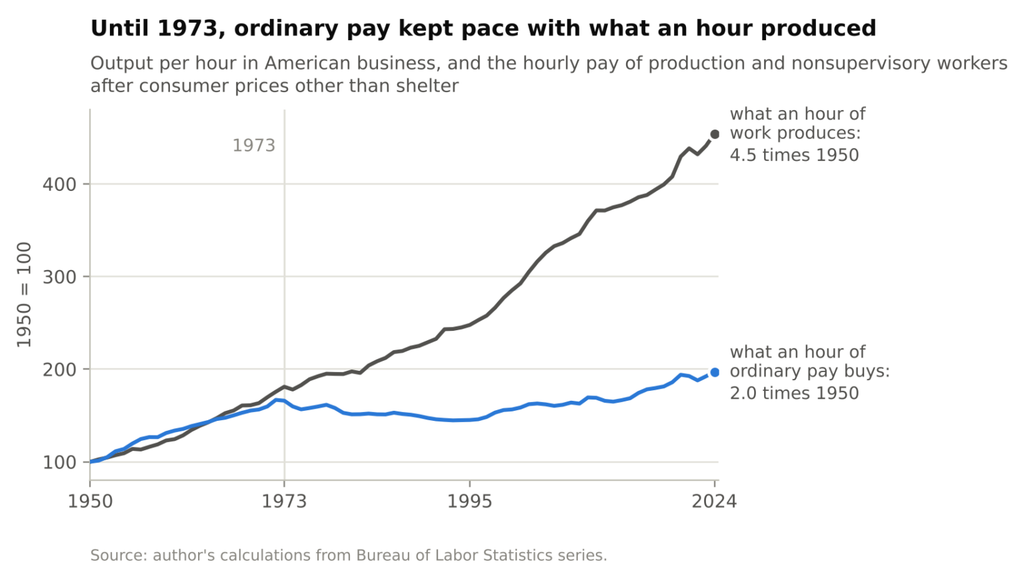
And that is when I realise: perhaps this issue isn’t one that vaguely sits ahead of us at some point in the future, perhaps it has already been affecting the economy. As a result, I write one of my more breathless posts in june of 2026. I focus in on two parts of a solution, a Universal Basic Income (UBI), funded by Value Added Tax, (VAT). There is an elegence to that pair of policies, in that they are in some sense mirrors of each other. The UBI can fund consumption, and a VAT collects money from consumption. It naturally pays for itself. It also makes calculating the impact of the policy pair quite elegant using US economic data, and I enlist the help of the latest AI models to work on putting some real numbers to my idea in a second post in june.
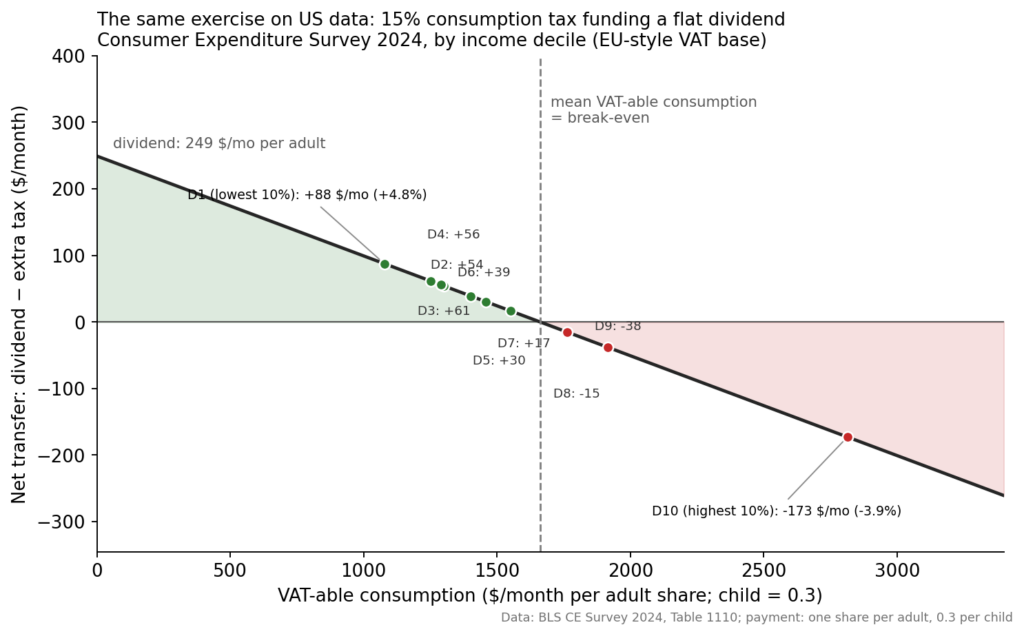
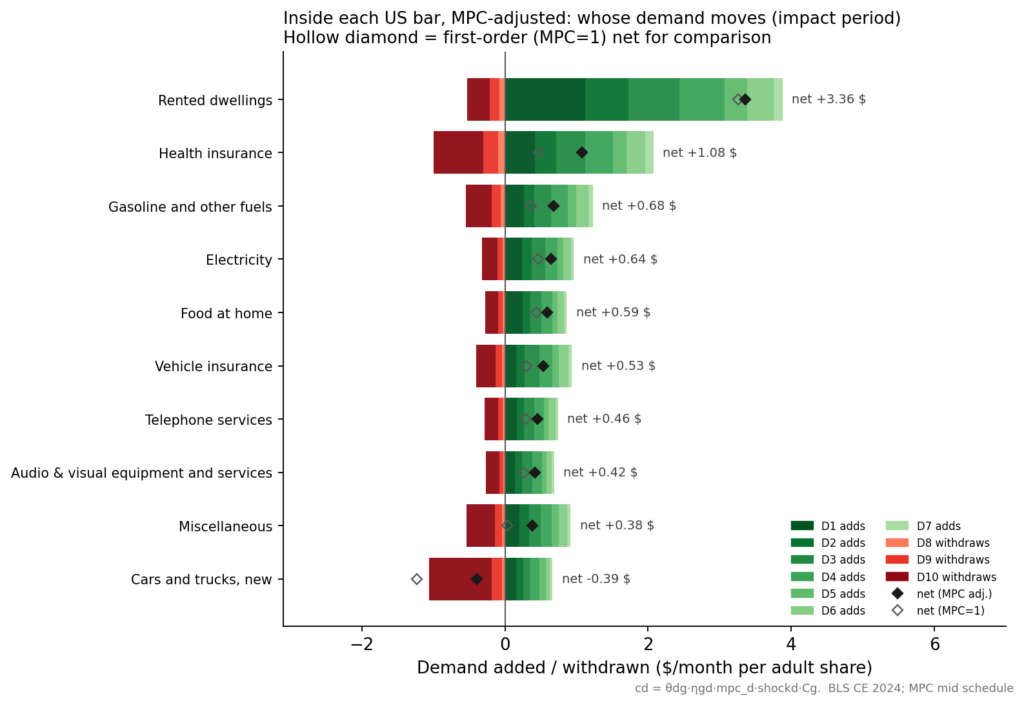
As I am working on this though, the AI models talk back at me. They tell me: my idea has flaws, that the money in the VAT-UBI loop will leak out. Most of all, it leaks out into rents, and around here is when I for the first time begin to read up properly on a guy named Henry George.
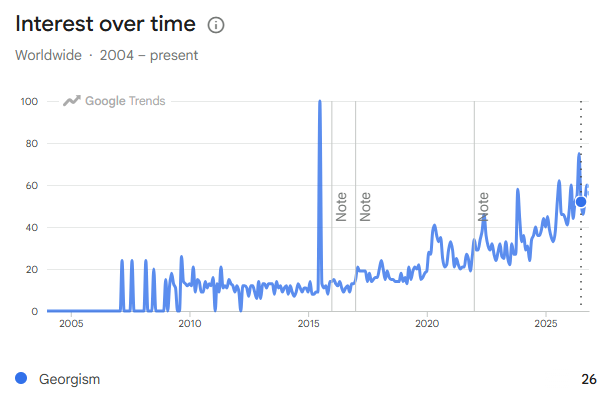
His story is very interesting. He writes a book on economics, Progress and Poverty, that sells extremely well. In it, he talks about how people should be able to keep the value of the things they create, meaning capital, but that things they did not create, only own, such as land, should be held by the public. He proposes that land value taxes (LVT) are important, even that they are the only tax we should have (I’ll get back to why he was sortof right, sortof wrong on this in a moment), and that they should fund a “citizens dividend”, which is essentially a UBI. His ideas were popular, and even though he is mostly forgotten now, if you’ve ever played monopoly you are playing a game that was originally created to teach people about Georgism and the value of land. Interestingly, Georgism is seeing somewhat of a revival, and I do not think that is a coincidence:
Anyways, now I begin to get more serious about all this. I’ve always liked economics, I’d heard about Daron Acemoglu and I start reading papers about automation, task models, displacement, factor shares, and all sorts of things to try and really answer the question at the beginning of this post. One morning, I wake up and write a post which I call “A New-ish Theory of Economics“, I hope you’ll forgive my arrogance but it felt significant, and in some ways I still think it is. Shortly thereafter, I ask Claude Fable to try and formalise it, iterate on it for months, and long story short, I end up with an equation, this one:
It is an equation for the wage-rent ratio, the ratio between what people earn, and what land and other fixed inputs earn. Around here I also start sharing this idea with a friend of mine at the Stockholm School of Economics, Johan Båge, and together we have a paper that we are trying to get reviewed:
Pinning the Wage to Scarcity and Technology by Johan Båge, Stella Wilson :: SSRN
Thereafter, I write many other posts, trying to illustrate different parts of the idea, and I also make a video in the style of 3blue1brown:
From here, there are a few more pieces to really finish off the idea, probably two more papers. One is regarding the “market distortion” aspect of the theory, for which I have a work-in-progress paper already:
Fair warning though, the prose still reeks of AI
The other piece is calibration. That means taking real data and figuring out if the model fits, and what it says about history and where we are now. The paper’s main equation is static, i.e it has no time, interest, or capital. To make it dynamic, we add depreciation and interest, and get this:
Having run the calibrations, I brought together those three pieces and wrote perhaps my most important post, “Why Are We Still Working This Hard?“. In case you are interested, here’s some more figures from the calibration:
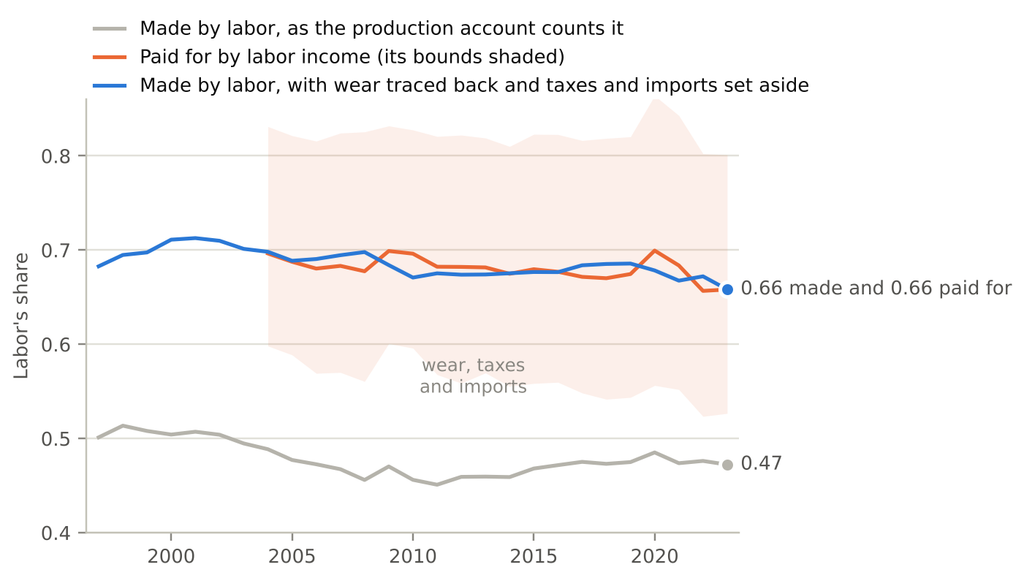
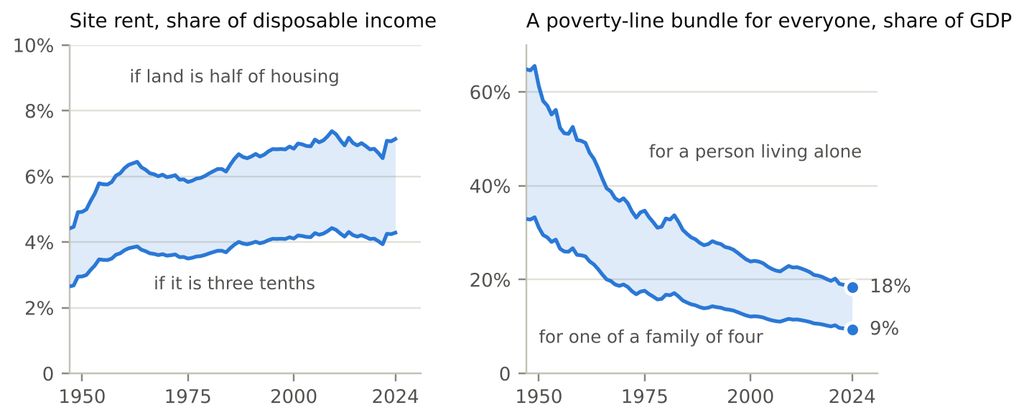
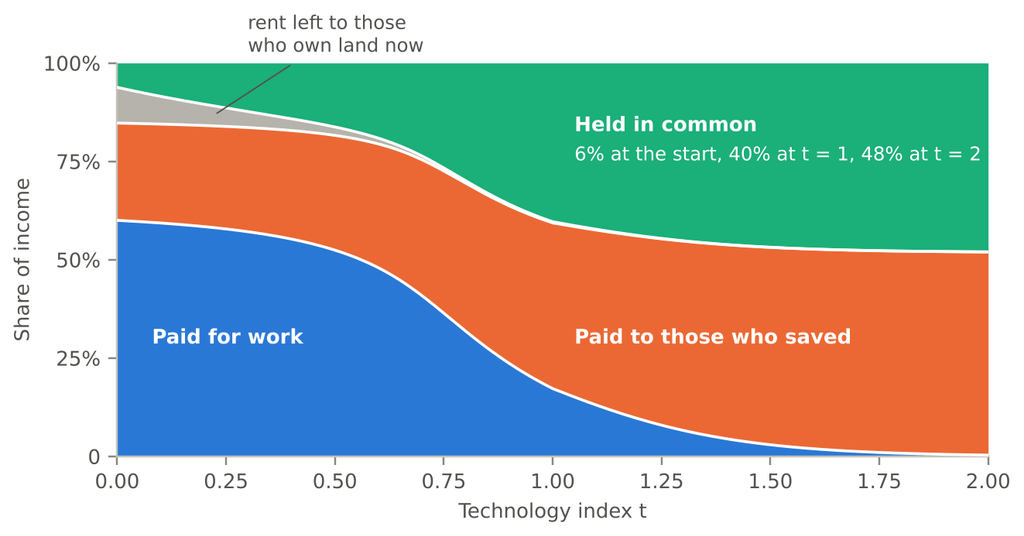
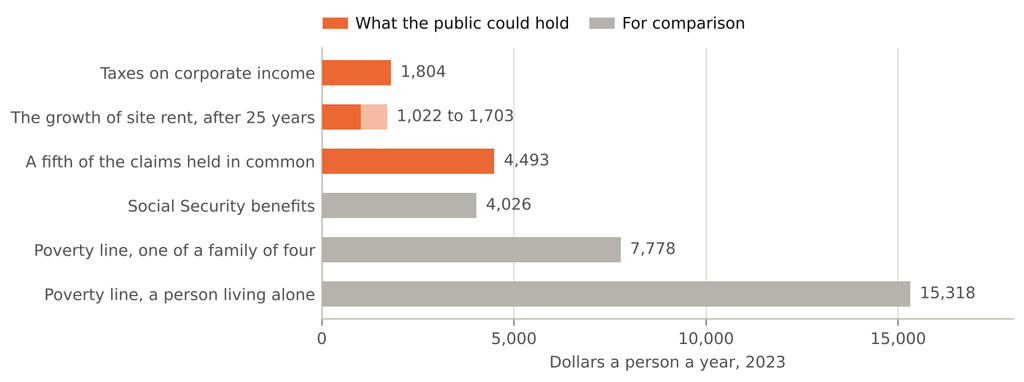
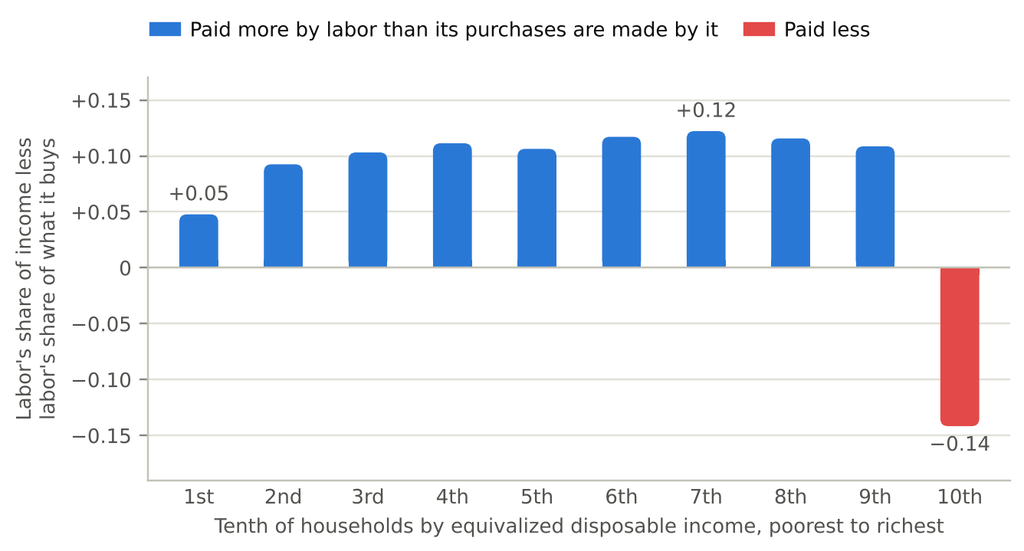
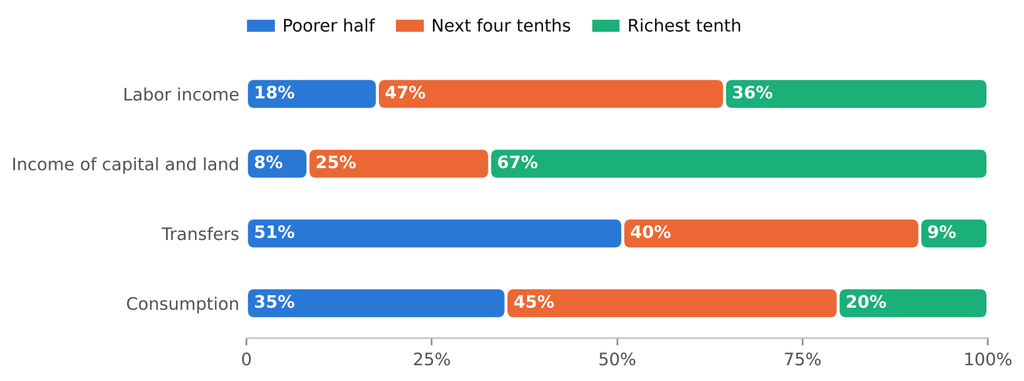
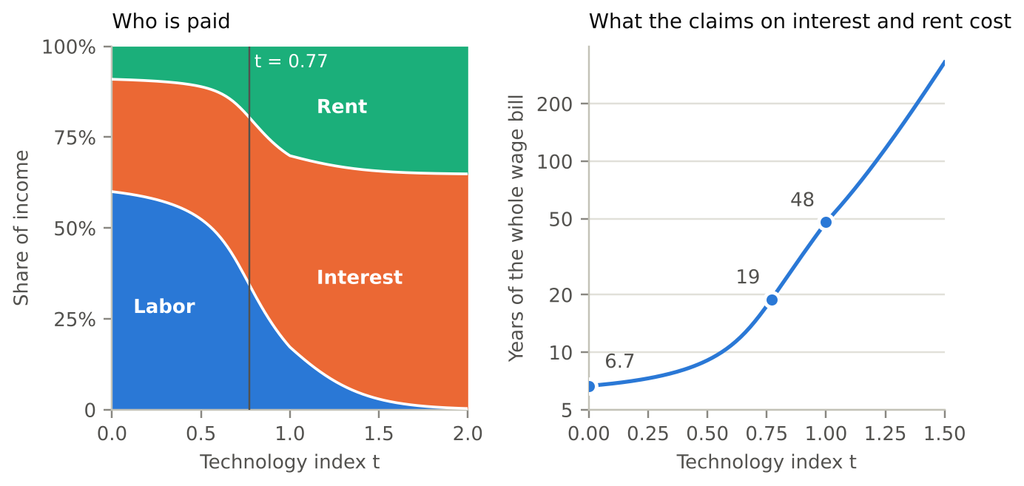
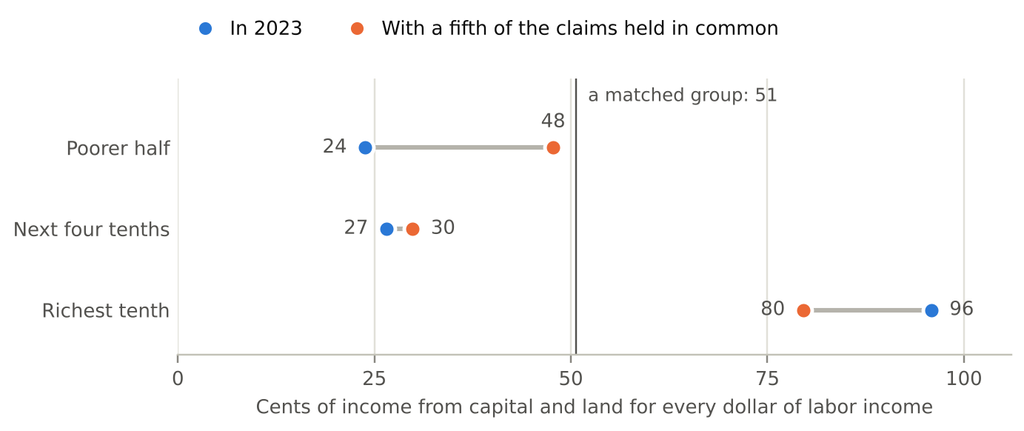
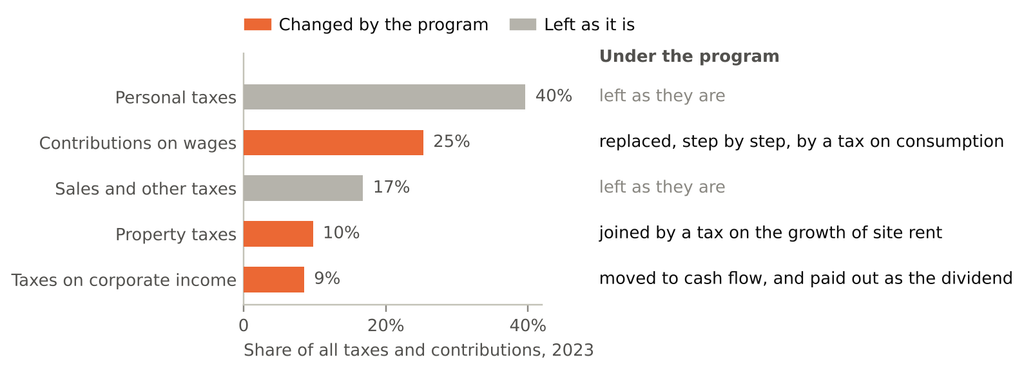
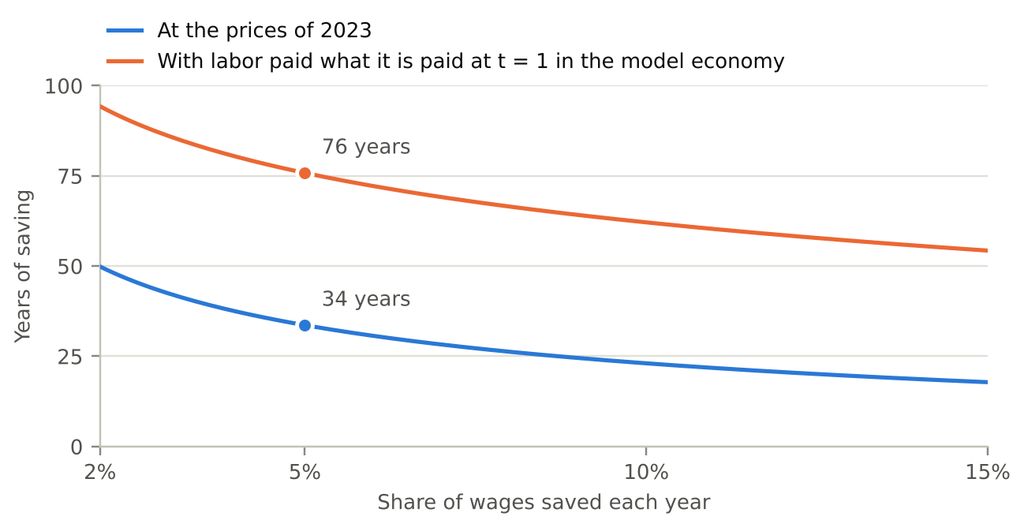
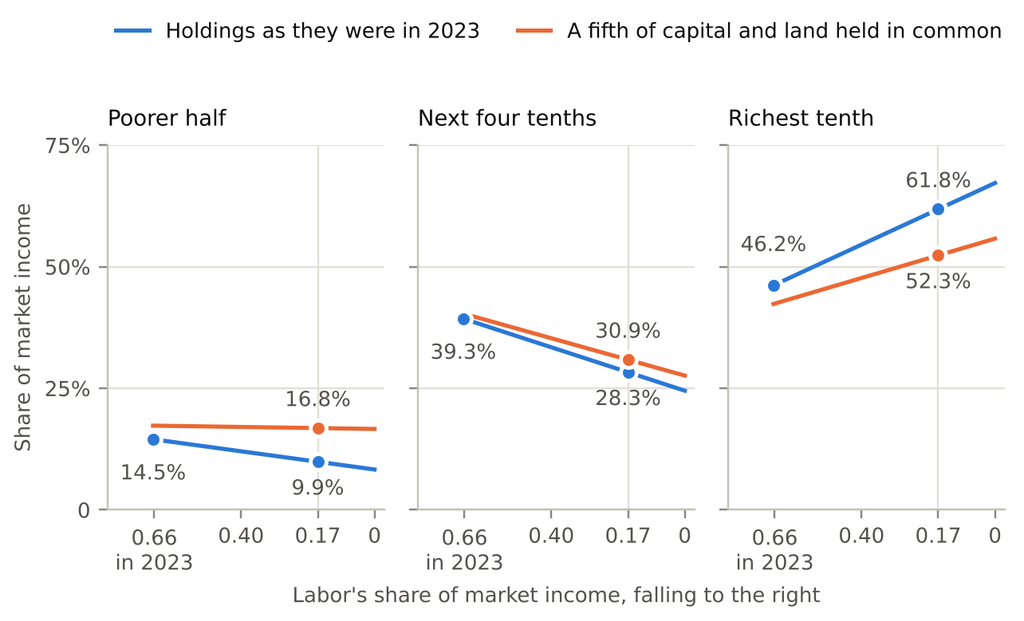
It’s here we can point out why Henry George was wrong. Return on capital will still very likely hold a significant place in any future economy, and even if you owned all the land there is no guarantee that it would be the distribution of resources that you want. For this reason, one has to have an efficient way for the government to take a share of the creation and use of capital, and it turns out that that is possible. I mention it briefly in “Why Are We Still Working This Hard?“, but the full version will likely be another paper.
And that’s where I am now. It’s been a bit of a mess, people have said it’s all slop because I used AI to help me, that the idea is too big, that maybe I am on drugs or have AI psychosis. I worried that might be true at times and I just didn’t notice, which is a scary thought. However, throughout a few people did actually take the time to listen to me, and to them I am very grateful. I hope you thought this was an interesting read, if you have any comments or questions you can reach me at wilson@wilsoniumite.com
No AI was used in the writing of any of the text of this piece, I didn’t even spell check it. The figures are all generated from code available on github at wilsoniumite/labor, for which I did use a lot of AI, and all the numbers come from publicly available US data.