To my previous post, “Why do we assume everyone should be working?“, one of the more common and good responses was “well, if people don’t work, lots of bad things will happen”. This is a very fair point, here are some of the good arguments I received:
- Many people find joy and purpose in work, and would lose that.
- Idle hands lead to more decline that we already worry about: Endless scrolling, glued to a screen, consuming misinformation, finding people to argue with.
- Work means people see the real world, and without it people become disconnected, will vote for fanciful, unrealistic people and policies. They won’t understand how much other people contribute to the economy, and will feel entitled to their output.
- We will stifle innovation, because even if machines can do the work, it’s very unclear if they can come up with new, good ideas.
- Who will watch the machines and make sure they do what we want?
All these are valid, and I have myself written about this problem in the abstract, in one of my first breakthrough posts: “We’ve lost our respect for complexity“. Near the end of that piece, I wrote:
[What do we do about it? …]
What? Don’t look at me like that? I didn’t promise you any solutions at the start of this text. It’s a complex problem, and it’d be genuinely ironic if I now gave you the fix-all solution. I have more respect for the problem than to try and do that in a blogpost.
I am now going to try to give you the fix-most-of-it solution in a blogpost. Go figure. One of the proposed solutions I have heard from others is essentially apprenticeships, internships, similar such things, funded in part by the state. One reason to do that instead of just more university is because I think we generally already feel more schooling having diminishing returns. Many people learn at a high level at university, hit the job market, and have to relearn a whole set of new stuff whilst forgetting what they learnt at uni (even if they got a job in the field they studied for!). Some countries already do this apprenticeship encouragement in part, cutting income taxes and even pension contribution requirements for people under a certain age (Sweden has something similar). It’s a decent solution but it has a specific problem, especially if AI lowers the slope of the task curve (see here for what that means).
Essentially that problem is The Paradox of Value. Even with stipends from the state, these internships will follow the curve of labor intensive tasks. This is good, even necessary, in many cases to encourage people to learn in fields where the economy actually needs people, but it also is the root cause of the problem in “we’ve lost our respect for complexity”. So, we need to put some people into fields even if those fields are heavily automated. One example is, well, literal fields. Watch Clarkson’s Farm and you will realise what I mean, the average person knows little about farming and yet, every single person needs to eat. The Paradox of Value is what is standing in the way here, where things we dearly rely on are economically unimportant if the industry is mature and margins are small and automation is high in that area. So, we have to try and estimate “true” value, rather than market implied value. That’s a dangerous thing to try and do, get it wrong and you easily do more harm than good, but for this case we have no other choice.
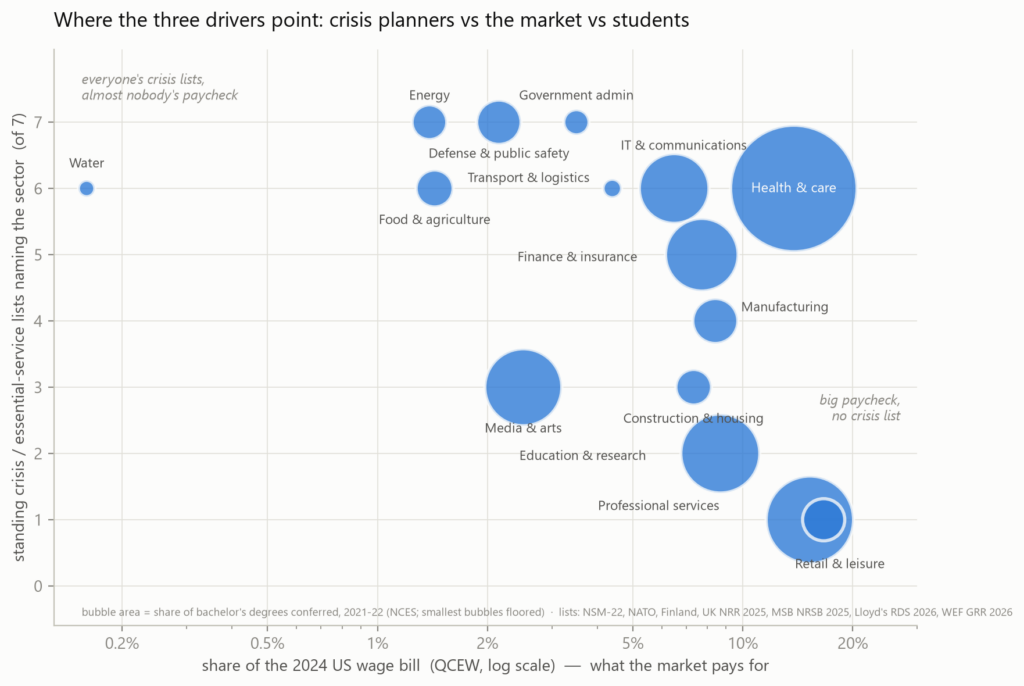
There are three things that we need to balance:
- What the market wants people to do: existing apprenticeship systems like in Sweden, and the current labor demand market serve this.
- What people want to do: Things that are prestigious or are their passions. When people choose a uni major but then don’t end up working in the field, usually that means this was misaligned with point 1.
- What our society relies on: This is the paradox of value mentioned above, currently very weakly served by curiosity and things like Clarkson’s Farm.
Let’s focus on 3 for a bit. The way that industry, academia, and government solve similar problems is by running shock scenarios. We ask “ok, things are running smoothly right now, but if crisis comes which industries are most affected, and how much is that effect multiplied by how much we need that industry to live?”. Do this for a few possible crises, and farming, water supply, energy supply, logistical systems, payment systems, healthcare, and communication systems all come out on top for pretty obvious reasons. You don’t just get a ranking but a value.
I’m now going to go into a hypothetical constructed solution, it’s going to sound very different from anything we have right now, and it’s designed for an equally hypothetical world where machines can do a great many tasks. OK: Imagine then that we have a pot of money, taxed from scarce factors which if you want to know why you’d do that please read “Working on Economics with Fable 5“. In fact, a lot of what follows is predicated on a system built around that finding, so if you haven’t yet read it it’s really worth reading. By not spending the pot on a UBI, we encourage working, because it lowers the UBI and tops up salaries instead. Governments balance this through democratic systems etc, I have (perhaps more than most) faith that this will work. I would then propose two kinds of post- or during-university placements:
- Short rotational placement.
- Long term placement.
This is kind of inspired by what we do at my work, a financial institution. Switching jobs internally is encouraged, interns do this as a matter of course. Short term placement students shadow long term placement individuals or workers, then after some set time move on to some other area. When they feel they’ve found something they like, they can stay there (our long term placement). In our hypothetical solution so as to not create two distinct classes of colleague, one placed there by the state and one placed there by the market, long term placement is achieved simply by topping up the wage of all workers in the field, so it conceptually exists but you wouldn’t be able to tell who is who. That means requiring everyone to obtain their job through the short rotation system, and a company needing to hire more people must pay for more short rotation access. Hiring from short into long term placement then works similarly to right now, wage negotiation, interviews, the works. To summarize:
- Everyone who wants a wage above a UBI enters the short rotation system.
- Short rotation positions are distributed by the state calculated shocked value plus company contributions. Often, these individuals will be, well, amateurs, and so their wage can’t really be market priced, so one might as well have it be fixed like the ubi just at a higher level. The distribution being a sum of two weighted pots of money serves our goals 1 and 3 in the balance problem. Perhaps one can have a little bit of preferred placement, for example if someone really wants to work in a field that also is currently underserved according to balance 1 or 3 or both, they may rotate there first and hop between companies in that field more often.
- People choose to stay at a place, and then go through the interview process. Where they choose to apply serves balance 2, interviews and wage negotiation serves balance 1, worker wage topup serves balance 3.
- Companies are not allowed to offer. That would reintroduce the state vs market class of colleagues. In fact one of the hardest parts might be companies tipping off who they want, but probably we all value healthy working environments so preferably they shouldn’t do that. Some enforcement of within role wage bands and transparency is probably necessary for the same reason. Fable tells me a good solution is matching systems which are already used, everyone applies by submitting a ranking, all employers submit their own ranking at the same time, and an algorithm does assignment. I can see maybe some issues with that, but someone smart might be able to work it out.
- One might add some rules, some minimum number of short term placements before one is allowed to apply.
- When choosing to apply one can apply to any of the short term positions one was previously in. This avoids feeling pressured to apply to a position you are finishing up.
- One might want to add a rule whereby after many short term placements your short term placement wage is slowly lowered. You will always receive the UBI, but at some point, it may be best for you to stop searching if you either see nothing you like or nobody wants to hire you. The second to last point here, free form rotation, serves as an additional possibility.
- State employers follow the exact same rules as companies. This should include academia for countries with state financed academia.
- If you want to switch roles, you may enter the short rotation system, or if a company really wants you, bypassing the short rotation system, they may have to pay a fee into the placement pot. That’s a particularly hard one, you need to balance labor market efficiency with our goal of employing people in automated fields, but it’s probably quite possible.
- Firing works as normal, and probably with a UBI states and unions could relax some degree of employment protections, improving labor market efficiency.
- Lastly, innovation, startups, self employment, and creativity. If you wish to you may also apply for short term rotation where you can do anything you want that isn’t tied to any company. Do art, music, found a company, study more, explore the world. You are paid the short term placement wage as normal. The rules are this: In this case, if you then apply afterwards, one of two things happen: You become your own long term employer as a company if you are able to earn money (or get private market investment, say, a founder), or you essentially become long term employed by the state itself. In the latter case, the state acts as an employer of last resort, however the state then needs to interview you and choose your wage. In part, the state then can use proxies or chosen areas of investment to help assess if they are willing to pay you for whatever it is you claim to want to do. The thinking is this: the UBI allows you to do whatever you want if you are able and willing to live off it. If you want more than that, you either need to convince a company, or “the people” via the state itself. That last option, employer of last resort, is incredibly hard to get right, one might exclude it especially from a pilot program, and hope the UBI is sufficient.
- Balancing all the above with actual numbers and rules is something democracy will have to work on.
Beyond the work system, we would want to fund other things. Funding programs like Clarkson’s Farm and educational networks also helps with making people understand the society they live in. Funding academia is important for getting unpriceable value from curiosity and innovation. Now let’s return to our critiques at the start of this piece and see if they are mitigated.
- Many people find joy and purpose in work, and would lose that. Now those that know or find their passion can work within it, even if the market wouldn’t price many roles there.
- Idle hands lead to more decline that we already worry about: Endless scrolling, glued to a screen, consuming misinformation, finding people to argue with. Decreasing the UBI and funding the short rotation and long term placement wages allow us to keep people busy, if we think that is a big risk (vote on if you think it is)
- Work means people see the real world, and without it people become disconnected, will vote for fanciful, unrealistic people and policies. They won’t understand how much other people contribute to the economy, and will feel entitled to their output. Mitigated in the same way as 1, but now we can encourage not just finding a job, but exploring many jobs if we fund the short rotation more than the long placement.
- We will stifle innovation, because even if machines can do the work, it’s very unclear if they can come up with new, good ideas. Supporting self employment, founding, academia and putting people into work helps this directly.
- Who will watch the machines and make sure they do what we want? The best form of oversight is to be knees deep in the work. I work in risk, and in truth it can be a bit unfulfilling. The more the work becomes just box ticking the more one begins to not care what the boxes say. Getting people involved is just the better way to achieve the same. Notably, this may mean allowing people to make mistakes even if a machine wouldn’t have, but we learn from failure so perhaps that is just a cost we need to bear if we want to understand our economy and society.
All these policies would be market distorting. In the fable economics post, the non distorting option is to just pay a full UBI and set the level by the rent base captured. But, intentional distortions are all about saying “hey, we actually think the market might be wrong about this thing, can we skew it?” and The Paradox of Value is one such thing.
Thanks for reading! All of this is just a hypothetical constructed idea, but something like it really would be necessary if machines do end up being quite good at many things.