I read a tweet the other day, “If AI makes a significant scientific discovery, but nobody understands it, does it matter?” and it seems like the answer is no, it doesn’t, because no matter how hard I try, nobody reads my damn paper.
Recently there’s been a lot of news and questions and discussions floating around I thought I’d create a handy dandy guide to understanding and answering them.
Grant Sanderson, the maths educator of 3blue1brown fame, recently started a series around the idea of “compression is intelligence”. He talks about information theory and how it relates to AI, and although the series only has a few entries, I’m already very fond of the general framing: that the ability to take the real world, distill something more fundamental out of it, and be able to relate that to other things in a useful way, is what intelligence is.
When I meet people who I think are really smart, I’ll often hear something like “yeah I didn’t study much during school”. When I say smart, I don’t mean that they know everything, but instead that they learn quickly, are good at teaching, can describe something abstractly, then link it to an example, then dive into the details, all with minimal effort. So obviously, these people didn’t need to study much, which forms a neat explanation. Except, I’ve just recently wondered if perhaps some causality may go the other way. By that I mean that part of the reason they are smart (by my definition) is because they didn’t study. Before you accuse me of being crazy, I want to talk about how we train AI, and more precisely, talk about memorisation versus generalisation in the field of machine learning.
When we train almost all AI systems, we often put in a huge amount of effort into just stopping the damn things from memorising. We sometimes call this overfitting, and there is a similar form called shortcut learning. If you have a picture of a bee, and you want a neural network to say “that’s a bee”, many naive methods will just find some small pattern of pixels in the image and learn “if I see those pixels there, it’s a bee”. This isn’t useful at all, usually it only works for exactly one picture of a bee and no other bees, and so you get amazing results on your training dataset and abysmal ones on your test. What we want the models to do is to generalise, we want them to learn “a bee has these colours and this shape and it has wings and this many legs” and to learn that it needs to learn “a leg is a thing where…” and “a wing is a thing that…” and so on and so on, all the way down to pixels, somehow. The reason doing this is hard is because with the wrong incentives, memorising is often so much “easier”. We usually train models iteratively, step by step, and at each step there’s only a few pictures or samples it needs to get better at judging. Why try to find some beautiful generalisable representation when just memorising some pixel rules is good enough for these 32 images or whatever? For this reason, big strides in machine learning have come from finding ways to stop models from memorising, or encourage them to take memorised concepts and generalise them. And to note, I use image classification as an example here given how tangible it is, but this problem generalises across pretty much all of machine learning.
Now back to us humans. I’ll use myself as an example human (yes, no AI was used in writing this, except for a few spelling checks at the end). I’ve always hated memorising things. Maybe it’s my ADHD but the why hardly matters, I never did times tables, I hated learning word translations in language classes, I never bothered to remember formulas (I’m immensely grateful for being allowed a formula book for many subjects). Instead, I’d describe wanting to always use intuition and get my answers during exams from building things up from first principles. In many ways, I had no other choice, my refusal to do most homework left it as my only option. For some things like languages, this didn’t work and that’s why I almost failed those classes. There’s hardly a consistent principle for masculine and feminine forms in French. So I was one of those “I didn’t study much” people, but I still attended every class, asked lots of questions, and I didn’t take notes. Instead, I let my mind wander as the teacher talked. It’d wander around the topic being taught and try to see how the topic connected to things I already knew (hopefully, sometimes I’ll concede I was on my phone).
Today, I work as a systems architect and I remain awful at remembering little things or forcing myself to learn small, arbitrary details. I’d call them “accidental complexity” and avoid them like the plague. But I learn quick, and seeing the big picture has been extremely valuable in my work. I wouldn’t really say one way of thinking is necessarily better than the other, but here’s the point that I’d like to make with this blog post: When we teach kids and construct curriculums, I think we should be much more careful in what kind of learning we incentivise. I’d make the bold statement that right now, we focus far too much on memorisation, and in so doing may be disincentivising people from developing fundamental understanding as they learn. I’m speculating massively here, but if each lost opportunity to generalise decreases the value of generalising in the next step then at some point you will hardly feel any need to, even if you would be better off in aggregate having some more fundamental intuition.
I don’t have any concrete ideas of what that would mean for teaching, but it does align a lot with what kinds of teachers I really appreciate. Grant Sanderson himself is a great example, he often tries to build that fundamental intuition and has also realised that sparking curiosity (for example with compelling storylines) is one of the best ways to do that.
Hopefully this post has been interesting to you. This idea itself is me generalising between topics like how teachers teach, how the field of ML has progressed, and how human brains learn, each of which i’ve learned about in academic settings but refused to just memorise. It might be a load of tenuously connected abstract junk (of which I will concede I do produce from time to time), or it may have some fundamental truth behind it. I leave that distinction up to you, feel free to write comments here.
As it has with many others, the advance of AI has had me thinking about humanity. Of course I’ve been thinking about humanity as the term for all of us, I’ve been writing a lot about that recently, but I’ve also been thinking about humanity as the property that we each have, i.e what it is to be human.
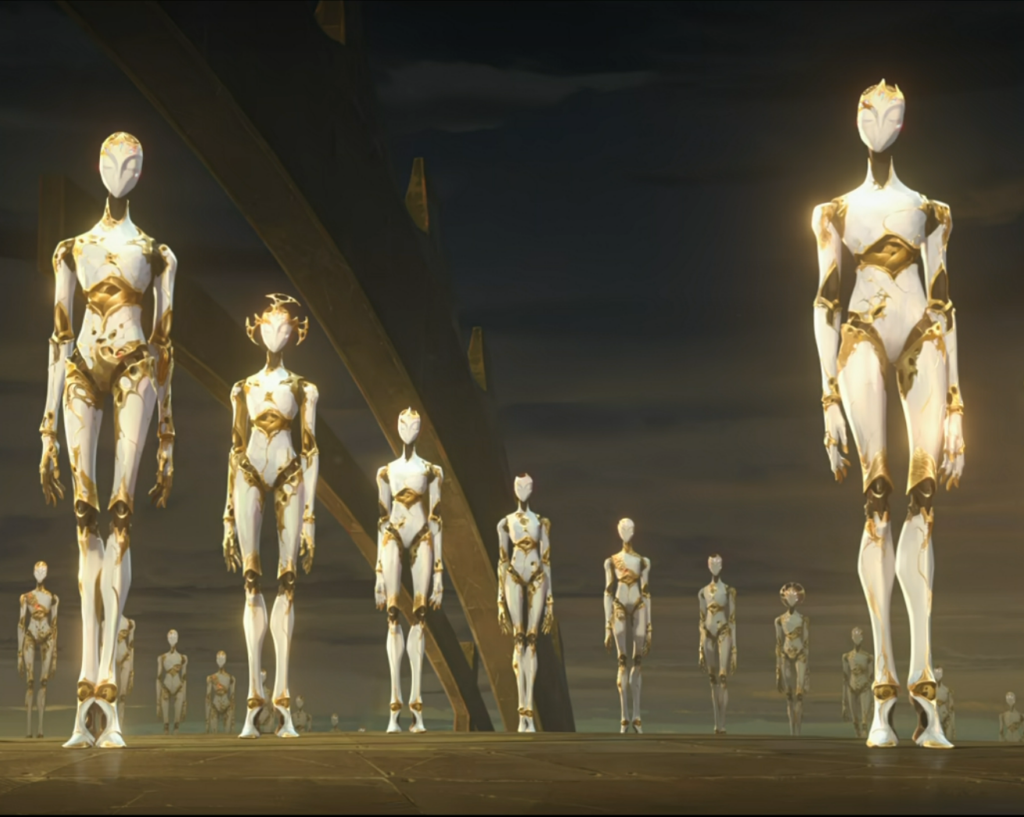
One of my favourite stories of all time is Arcane. Spoilers ahead. In it, a character named Viktor becomes the “Machine Herald”, healing the imperfections of people and ultimately setting out to “fix” humanity. The constructs that individuals ultimately become look like this:
Gold and white, slender, fast yet strong, powerful, perfect, and faceless.
I’m not sure if the writers had our modern AI in mind when they wrote Arcane, but I cannot help but think of it as a perfect analogy. These days, mathematician Terence Tao worries that the proofs and prose generated by the latest AIs is actually too good. Readers on hackernews now sometimes praise the odd spelling error as a sign that the text is human. In experiments on story writing, although AI texts now often can win blind judging tests, the stories they write can be both felt and measured to be like copies of one another with only superficial changes.
This shouldn’t come as a surprise. During pretraining models are trained to approximate the average human in terms of what makes anyone unique, and then with reinforcement learning they are trained to reach a point of perfection on every facet that can be measured. Perfection is a fixed point, and with enough effort a great many things can be measured, placed on a scale of better or worse, and optimized towards. I believe that all that will be left for us is our flaws, or the things for which we can finally let go of the concept of better or worse (a hard thing to do).
I remember talking to a friend of mine about one of her favorite artists, H. R. Giger. He developed the art style for Alien, amongst other things, and the uniqueness of his work is sometimes attributed to the trauma he suffered when he was younger. I don’t think that true creativity has to come from trauma, but I do believe that the uniqueness of our lived experiences is the one thing a machine could not ever emulate. To perfectly accurately copy everything necessary to create a work that captures the life of an individual, it feels intuitive that one would have to simulate that individuals life in it’s entirety. Meaning, the only thing I feel confident in claiming that an AI will never manage to do is represent all of the unique complexity of every individual perfectly, as the only way to do that is, well, a matrix style perfect simulation. And that would be rather pointless, because we have our real version right here.
As I look around and see people beginning to understand just how “good” AI has become, I see a lot of emotions. Denial, that it simply isn’t as good as some say, is common. Anger goes without saying. One of the more common ones in the most effected fields like programming and maths is now depression. An understanding that these models really do achieve real results, and not being sure what is left for oneself. I also felt that, but have since come to a different conclusion.
I’ve decided that I want love all our flaws and imperfections. Some I would still try to fight against or change, but I believe all of them to be natural and would never chose to exclude any from the definition of humanity. On the contrary, to err really is what makes us human. I genuinely do believe that diversity is strength, but indeed, going forward, it may now be our only strength. We have to find a way to love it, both within ourselves, and in eachother.
To my previous post, “Why do we assume everyone should be working?“, one of the more common and good responses was “well, if people don’t work, lots of bad things will happen”. This is a very fair point, here are some of the good arguments I received:
Many people find joy and purpose in work, and would lose that.
Idle hands lead to more decline that we already worry about: Endless scrolling, glued to a screen, consuming misinformation, finding people to argue with.
Work means people see the real world, and without it people become disconnected, will vote for fanciful, unrealistic people and policies. They won’t understand how much other people contribute to the economy, and will feel entitled to their output.
We will stifle innovation, because even if machines can do the work, it’s very unclear if they can come up with new, good ideas.
Who will watch the machines and make sure they do what we want?
All these are valid, and I have myself written about this problem in the abstract, in one of my first breakthrough posts: “We’ve lost our respect for complexity“. Near the end of that piece, I wrote:
[What do we do about it? …]
What? Don’t look at me like that? I didn’t promise you any solutions at the start of this text. It’s a complex problem, and it’d be genuinely ironic if I now gave you the fix-all solution. I have more respect for the problem than to try and do that in a blogpost.
I am now going to try to give you the fix-most-of-it solution in a blogpost. Go figure. One of the proposed solutions I have heard from others is essentially apprenticeships, internships, similar such things, funded in part by the state. One reason to do that instead of just more university is because I think we generally already feel more schooling having diminishing returns. Many people learn at a high level at university, hit the job market, and have to relearn a whole set of new stuff whilst forgetting what they learnt at uni (even if they got a job in the field they studied for!). Some countries already do this apprenticeship encouragement in part, cutting income taxes and even pension contribution requirements for people under a certain age (Sweden has something similar). It’s a decent solution but it has a specific problem, especially if AI lowers the slope of the task curve (see here for what that means).
Essentially that problem is The Paradox of Value. Even with stipends from the state, these internships will follow the curve of labor intensive tasks. This is good, even necessary, in many cases to encourage people to learn in fields where the economy actually needs people, but it also is the root cause of the problem in “we’ve lost our respect for complexity”. So, we need to put some people into fields even if those fields are heavily automated. One example is, well, literal fields. Watch Clarkson’s Farm and you will realise what I mean, the average person knows little about farming and yet, every single person needs to eat. The Paradox of Value is what is standing in the way here, where things we dearly rely on are economically unimportant if the industry is mature and margins are small and automation is high in that area. So, we have to try and estimate “true” value, rather than market implied value. That’s a dangerous thing to try and do, get it wrong and you easily do more harm than good, but for this case we have no other choice.
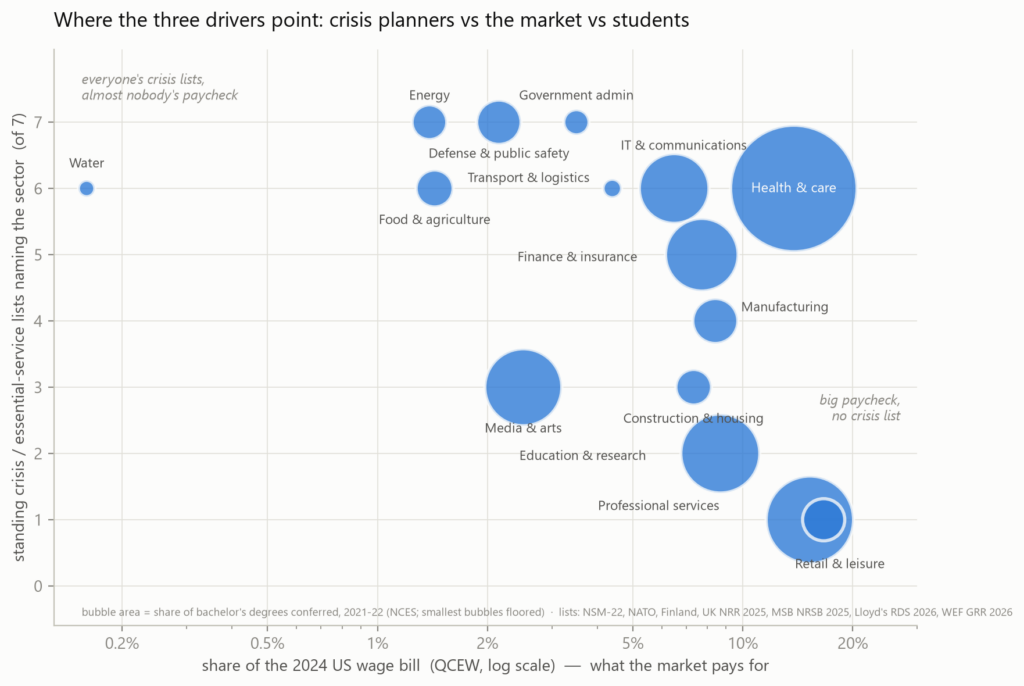
There are three things that we need to balance:
What the market wants people to do: existing apprenticeship systems like in Sweden, and the current labor demand market serve this.
What people want to do: Things that are prestigious or are their passions. When people choose a uni major but then don’t end up working in the field, usually that means this was misaligned with point 1.
What our society relies on: This is the paradox of value mentioned above, currently very weakly served by curiosity and things like Clarkson’s Farm.
Let’s focus on 3 for a bit. The way that industry, academia, and government solve similar problems is by running shock scenarios. We ask “ok, things are running smoothly right now, but if crisis comes which industries are most affected, and how much is that effect multiplied by how much we need that industry to live?”. Do this for a few possible crises, and farming, water supply, energy supply, logistical systems, payment systems, healthcare, and communication systems all come out on top for pretty obvious reasons. You don’t just get a ranking but a value.
I’m now going to go into a hypothetical constructed solution, it’s going to sound very different from anything we have right now, and it’s designed for an equally hypothetical world where machines can do a great many tasks. OK: Imagine then that we have a pot of money, taxed from scarce factors which if you want to know why you’d do that please read “Working on Economics with Fable 5“. In fact, a lot of what follows is predicated on a system built around that finding, so if you haven’t yet read it it’s really worth reading. By not spending the pot on a UBI, we encourage working, because it lowers the UBI and tops up salaries instead. Governments balance this through democratic systems etc, I have (perhaps more than most) faith that this will work. I would then propose two kinds of post- or during-university placements:
Short rotational placement.
Long term placement.
This is kind of inspired by what we do at my work, a financial institution. Switching jobs internally is encouraged, interns do this as a matter of course. Short term placement students shadow long term placement individuals or workers, then after some set time move on to some other area. When they feel they’ve found something they like, they can stay there (our long term placement). In our hypothetical solution so as to not create two distinct classes of colleague, one placed there by the state and one placed there by the market, long term placement is achieved simply by topping up the wage of all workers in the field, so it conceptually exists but you wouldn’t be able to tell who is who. That means requiring everyone to obtain their job through the short rotation system, and a company needing to hire more people must pay for more short rotation access. Hiring from short into long term placement then works similarly to right now, wage negotiation, interviews, the works. To summarize:
Everyone who wants a wage above a UBI enters the short rotation system.
Short rotation positions are distributed by the state calculated shocked value plus company contributions. Often, these individuals will be, well, amateurs, and so their wage can’t really be market priced, so one might as well have it be fixed like the ubi just at a higher level. The distribution being a sum of two weighted pots of money serves our goals 1 and 3 in the balance problem. Perhaps one can have a little bit of preferred placement, for example if someone really wants to work in a field that also is currently underserved according to balance 1 or 3 or both, they may rotate there first and hop between companies in that field more often.
People choose to stay at a place, and then go through the interview process. Where they choose to apply serves balance 2, interviews and wage negotiation serves balance 1, worker wage topup serves balance 3.
Companies are not allowed to offer. That would reintroduce the state vs market class of colleagues. In fact one of the hardest parts might be companies tipping off who they want, but probably we all value healthy working environments so preferably they shouldn’t do that. Some enforcement of within role wage bands and transparency is probably necessary for the same reason. Fable tells me a good solution is matching systems which are already used, everyone applies by submitting a ranking, all employers submit their own ranking at the same time, and an algorithm does assignment. I can see maybe some issues with that, but someone smart might be able to work it out.
One might add some rules, some minimum number of short term placements before one is allowed to apply.
When choosing to apply one can apply to any of the short term positions one was previously in. This avoids feeling pressured to apply to a position you are finishing up.
One might want to add a rule whereby after many short term placements your short term placement wage is slowly lowered. You will always receive the UBI, but at some point, it may be best for you to stop searching if you either see nothing you like or nobody wants to hire you. The second to last point here, free form rotation, serves as an additional possibility.
State employers follow the exact same rules as companies. This should include academia for countries with state financed academia.
If you want to switch roles, you may enter the short rotation system, or if a company really wants you, bypassing the short rotation system, they may have to pay a fee into the placement pot. That’s a particularly hard one, you need to balance labor market efficiency with our goal of employing people in automated fields, but it’s probably quite possible.
Firing works as normal, and probably with a UBI states and unions could relax some degree of employment protections, improving labor market efficiency.
Lastly, innovation, startups, self employment, and creativity. If you wish to you may also apply for short term rotation where you can do anything you want that isn’t tied to any company. Do art, music, found a company, study more, explore the world. You are paid the short term placement wage as normal. The rules are this: In this case, if you then apply afterwards, one of two things happen: You become your own long term employer as a company if you are able to earn money (or get private market investment, say, a founder), or you essentially become long term employed by the state itself. In the latter case, the state acts as an employer of last resort, however the state then needs to interview you and choose your wage. In part, the state then can use proxies or chosen areas of investment to help assess if they are willing to pay you for whatever it is you claim to want to do. The thinking is this: the UBI allows you to do whatever you want if you are able and willing to live off it. If you want more than that, you either need to convince a company, or “the people” via the state itself. That last option, employer of last resort, is incredibly hard to get right, one might exclude it especially from a pilot program, and hope the UBI is sufficient.
Balancing all the above with actual numbers and rules is something democracy will have to work on.
Beyond the work system, we would want to fund other things. Funding programs like Clarkson’s Farm and educational networks also helps with making people understand the society they live in. Funding academia is important for getting unpriceable value from curiosity and innovation. Now let’s return to our critiques at the start of this piece and see if they are mitigated.
Many people find joy and purpose in work, and would lose that. Now those that know or find their passion can work within it, even if the market wouldn’t price many roles there.
Idle hands lead to more decline that we already worry about: Endless scrolling, glued to a screen, consuming misinformation, finding people to argue with. Decreasing the UBI and funding the short rotation and long term placement wages allow us to keep people busy, if we think that is a big risk (vote on if you think it is)
Work means people see the real world, and without it people become disconnected, will vote for fanciful, unrealistic people and policies. They won’t understand how much other people contribute to the economy, and will feel entitled to their output. Mitigated in the same way as 1, but now we can encourage not just finding a job, but exploring many jobs if we fund the short rotation more than the long placement.
We will stifle innovation, because even if machines can do the work, it’s very unclear if they can come up with new, good ideas. Supporting self employment, founding, academia and putting people into work helps this directly.
Who will watch the machines and make sure they do what we want? The best form of oversight is to be knees deep in the work. I work in risk, and in truth it can be a bit unfulfilling. The more the work becomes just box ticking the more one begins to not care what the boxes say. Getting people involved is just the better way to achieve the same. Notably, this may mean allowing people to make mistakes even if a machine wouldn’t have, but we learn from failure so perhaps that is just a cost we need to bear if we want to understand our economy and society.
All these policies would be market distorting. In the fable economics post, the non distorting option is to just pay a full UBI and set the level by the rent base captured. But, intentional distortions are all about saying “hey, we actually think the market might be wrong about this thing, can we skew it?” and The Paradox of Value is one such thing.
Thanks for reading! All of this is just a hypothetical constructed idea, but something like it really would be necessary if machines do end up being quite good at many things.
I was talking to a friend of mine and I asked this. She said “of course everyone should be working, I mean, I’d like to be able to buy more stuff”
In that statement though there really is a non obvious implied logic. So the next question: does economics support that statement always? That if we want more stuff, and better lives, everyone should be working harder? No, only sometimes; in economics, utilizing a resource to it’s fullest at all times is not a given. Labor is a resource, like water, and yet we do not drain the oceans with the same fervour as we employ people, trying to find a job for every drop.
When we have implicit assumptions such as these, it drives our decision-making. A politician should not need to hunt for job creating policies, and yet they do because admittedly the alternative is poverty. Not because the economy couldn’t provide for that person, but because the only way for the economy to provide for them is through the wage.
Here is a very simple statement which may sound a bit mean: it is entirely feasible that giving a job to a “stupid” person, regardless of how much we try and train them, might cost the economy more than we benefit, in aggregate.
Disagree all you want on the definition of “stupid”, but you cannot deny that such a bar exists, and notably, that that bar can move up or down. There’s a strong argument to be made that it’s recently only been moving up as technology improves. What that means is, there may well be cases where the economy would actually like to pay someone to stay out of the labor force, but right now, it can’t. Remember when oil prices went negative? It can feel paradoxical that that can happen, but at least for oil, the economy has the power to set that price negative to essentially say “hey, I don’t want more of this right now”.1
We have to stop assuming that the economy wants everyone to be working. Otherwise, we may be silently strangling it with labor. Our current systems of taxes and benefits almost entirely assume we need everyone. By the findings of Acemoglu and Restrepo 2026, there’s already good evidence that for the past 40 something years, this assumption has been hurting us.
I’ve worked on this idea for a couple years now, and somehow, it managed to culminate in a formal theory of how wages are set, also based on Acemoglu and Restrepos task framework. You can read about it here:
Negative interest rates are the same but for capital. It’s the economy saying “hey, I don’t have any ideas for what to build right now, I don’t need this money”. You might say that those are set by central banks, but they are just doing it to try and raise inflation, and inflation is itself an aggregate demand signal so in the end, yes, it’s a glut of money that doesn’t know how to be spent. ↩︎
So, these AI models have been pretty good at finding bugs and exploits in all sorts of code.
Not only that, they’ve managed to prove quite a bit of maths, from insignificant to quite significant.
Maybe one might doubt the significance of those findings, but for those that think there’s at least some merit to them, perhaps you’ll be interested in this one:
I’ve come to realise that the true implications of my piece here aren’t quite as clear as I would have hoped, so this piece serves to make that a bit more obvious.
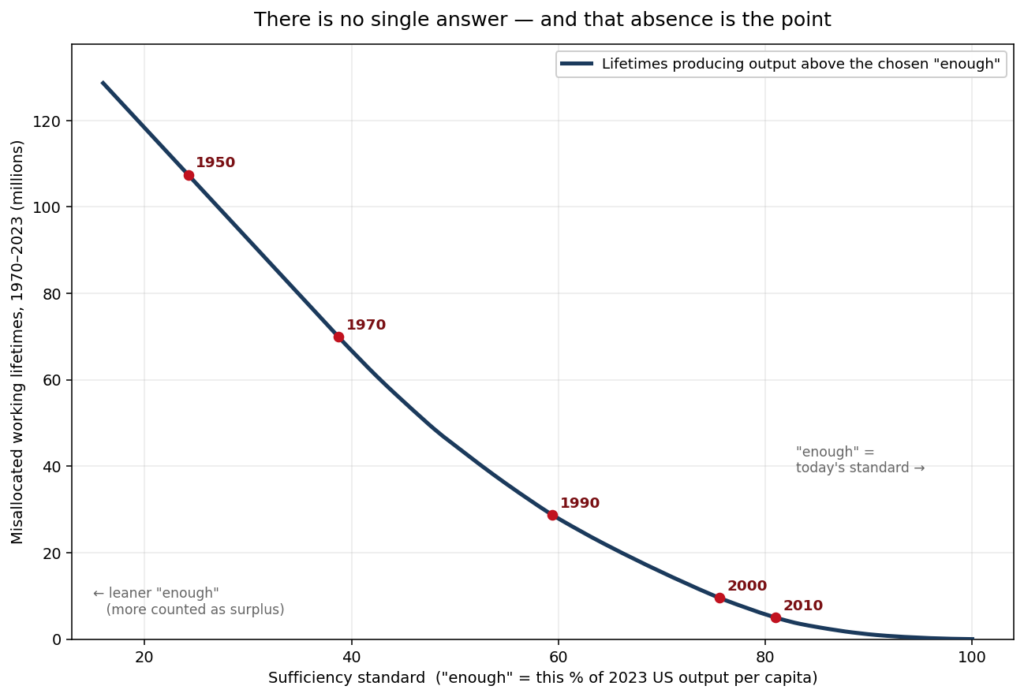
The thesis in the other two pieces, which I recommend reading since I won’t do any justifying here that isn’t already done there, is that through textbook market distortion we have systematically misallocated the productive hours of all people. Before you say “but without that labor, we would not have had the development and growth that we have!”, go read the other pieces, and consider that the core, efficient use of labor would not have been lost. What is lost is the make-work hours that is, in economic terms, misallocated. Calculating how much can be done by calculating how many hours were spent to raise output above a certain level for a given year. (This is admittedly an upper estimate and the true line will be below this line, but not necessarily much lower)
Figure 1: US working lifetimes spent producing output above a chosen “sufficiency standard,” 1970–2023. Each point on the curve answers: if “enough” is fixed at the real output-per-capita level s, how many full working lifetimes of US labor went into producing the aggregate output above that level between 1970 and 2023?1
What the thesis implies: We have not been allowed to choose a point on this curve. I don’t mean that we should have collectively chosen one, it’s just that each individual has been denied the right to choose any point on this graph beyond the current, 2026 point.
People cannot simply choose to take more leisure time because the ability to take leisure is still conditioned almost entirely on labor. To take time off, you have to save up. To save up, you have to work. Labor is distorting the real value of leisure if the production of that leisure needs less labor due to automation (leisure time still requires production so you can be fed, housed, and more if you go on holiday, travel, or consume to keep yourself entertained or educated).
And if you are wondering “If I choose 1990, do we lose the internet?” or “If I choose 1970, wouldn’t the economy collapse?” the answer is almost certainly not. To the first question, research still happens through R&D and universities, technology still would progress. To the second question, the economy is incredibly adaptable, if work needs doing, even with a base rate of consumption, it will raise wages until working is attractive. The system has not been allowed to function as it should.
I cannot tell you how many lifetimes of labor went misallocated exactly. To know that requires collecting the aggregate data from all people about where they believe they should be on this curve, in terms of what their labor is worth versus what they want to consume (in terms of consuming both goods and leisure). That is exactly what the economy is meant to do, to find that aggregate. Right now, it cannot. However, the answer is obviously in the millions of lifetimes.
Millions of lifetimes spent, for what?
Millions of lifetimes that, had labor been able, would most likely have been put into leisure. Do not forget, leisure means taking care of parents, of kids, of meeting friends in third spaces. All these things we wondered how we managed to lose. This distortion has been the largest calamity of the modern era.
This is a shorter piece. The full justification, evidence from data, and the solution, is here, please read it. I may very well be wrong, which to be honest would be comforting to feel right about now. If you have good responses to the original piece, please contact me at “wilson(at)wilsoniumite.com”
Footnotes:
Formally, with one working lifetime defined as W = 72,000 h (40 full-time years × 1,800 h/yr) L(s) = (1/W) · Σ₍ₜ₌₁₉₇₀₎^₂₀₂₃ Hₚᵥ(t)·N(t)·max(1 − s/y(t), 0) where Hₚᵥ(t) = per-worker annual hours, N(t) = persons employed, y(t) = real output per capita, and s = a fixed real output-per-capita level. Total hours worked in year t are Hₚᵥ(t)·N(t); the factor max(1 − s/y(t), 0) is the share of that year’s output exceeding the per-capita standard s, so years before the economy reaches s (and recession dips below it) contribute zero. The x-axis expresses s as a percentage of 2023 output per capita, s/y(2023)·100; the curve is evaluated on a 500-point grid from 0.16·y(2023) to y(2023). Red markers sit at s = y(T) for the calendar benchmarks T ∈ {1950, 1970, 1990, 2000, 2010}, i.e. “hold the year-T standard of living” (values: 107.4, 69.9, 28.7, 9.5, 5.0 million lifetimes respectively; the 2020 standard gives 1.1M). ↩︎
I don’t speak Chinese, but you are very welcome to ask one of the AI models to translate this into your language. I did learn Mandarin for a couple years when I was 17-18, but I wasn’t very good at it. However, I did manage to visit China and it was a very nice trip. If I remember correctly, our teacher mainly wanted to go to buy a proper, real rice cooker (she is Chinese).
I’ve been working on a theory of economics, and was wondering how your economy relates. I have a link here:
My theory, if I am applying it correctly, would congratulate you on doing some of the more important parts many other countries have not. Land leases are something my theory predicts would work quite well, though as consistent flows rather than lump sums. Additionally, state owned banks and state owned enterprises, although not necessarily optimal, are still probably decently effective. You could tune them a bit more, my recommendation is you should, but I won’t try and pretend I have a right to tell you what to do.
However, my theory predicts you need something that you don’t currently have much of. I heard recently that your government plans to find jobs for everyone. This might work for a while, but it probably isn’t necessary, and may do some damage in the long run. Instead, you should use an unconditional dividend, small at first, and you can grow it if it works well. All I ask is that your best and smartest people take a look at my theory and decide for yourselves if you think it makes sense. Good luck! 🙂
And if you have any thoughts or questions, please email me at wilson@wilsoniumite.com
All these are my interpretations of the theory, just me mulling over what it might mean. They are not nearly as rigorously checked as the core theory. The rigorous predictions are in Fable’s rigorous document. I’ll add more of my own here as they pop into my thoughts, and if I realize some are false, I’ll strike them (but not delete them). I know it’s like, a looooot, and makes me sound like a theory-of-everything crank, but history has shown economics is a pretty damn strong driver of humans. Better to write it down than not at all eh?
Things that it predicts from the past (and present)
Subsistence existence prior to the industrial revolution.
The empowerment of labor during the industrial revolution
That even during times of great prosperity and progress, there are individuals who seem almost paradoxically1 poor.
That the economy would begin to falter as the capability of technology becomes more uniform – A reasonable take is that computers, starting to do some degree of cognitive work, would cause a stagnation in developed economies. Perhaps even, a “great” one, starting around the 70s
The need for patent laws
That the left vs right debate seems intractable, unsolvable.
Sovereign bond yields rising
Things that a reasonable extension of it predicts from the past (and present)
Why Henry George was ignored during his time, despite very few strong critiques of his work. (His book was very popular and well regarded, but it didn’t lead to any real change). He wrote it at a time it was needed the least, and then was mostly forgotten.
The prevalence of feudalism prior to the industrial revolution
Slavery and serfdom, and subsequent abolition.
Democratisation during the industrial revolution and shortly after
The backsliding of democracy since the 90s and polarisation of the political spectrum.
Diversification is a good idea
Buying index funds is a better idea. Don’t pick stocks. (unless you have insider information)
Buying the global index fund is a really good idea.
Buying companies that own things but not ideas is the best idea. (given infinite time)
Given the above, the need for base research (untargeted curiosity, paid for without expectation of valuable return). Probably we should use some of the LVT flat rate and VAT to fund it.
The existence of economic bubbles
Falling fertility rates.
Simultaneous unemployment for some and long working hours for others.
Influencers (and maybe even vtubers and beauty filter influencers???)
The weakening of anti trust over time. (when rent seeking is the main way a person can claim value, and real value creation is becoming hard to find, of course we would have little political will for anti trust)
The reason why the USA has more growth but long hours, the EU has nicer protections but low growth, and why China just seems to be doing amazing all around (economically!).
Things that it might predict for the future (should we do nothing)
Not just a return to subsistence, but unlivable standards.
Slavery again (this is likely wrong because if labor is unimportant, you have no reason to own slaves)
War, strife. Just, awful human decline.
Things that it might predict for the future, with a land loop but without a good pigouvian implementation.
Runaway consumption.
Even with our current explosion of solar power, probably nasty runaway climate change.
Exhausting of natural resources, and a speed bump in growth as we are forced to extract from less efficient sources like landfills.
A population explosion.
Things that it might predict for the future, with a good pigouvian implementation.
To be honest I don’t want to think about it too much, it’s just… too nice. And it makes me sad for where we are. And sad for all those that perhaps suffered needlessly
For the past few months I’ve been working on a theory. It started out as just a fun little data exercise looking at some different types of taxes and benefits and how it effects what people buy and how much they work. During that time I took advantage of opus and later fable to help me get data, but as I was doing that of course opus might interject with some assumption I had wrong or some paper that shows the opposite. This back and forth continued for some time, and, well, it’s culminated in a theory. I’ve since started working alongside my co-author from the Stockholm School of economics on formalizing the theory
My original version, in my voice. Visual, anecdotal, not much in the way of maths or technical details.
The paper. The same theory, but formal. Very similar to the framework developed by nobel prizewinning economist Daron Acemoglu alongside Pascual Restrepo.
The paper uses the same task based model of Acemoglu and Restrepo, and essentially we add the logic of classical economics and input-output recursion to it to “pin” the wage. That is significant because, well, current economics doesn’t know how wages are set in aggregate. That might sound surprising but essentially all wage models are estimates or they have some free parameters you can change or have to supply some other way. All we did was assume “hey, maybe the classical economists were right, they just didn’t know about how technology can effect the wage”. So, all we need to do is take the scarcity models of classical economists, add on the wage level from the marginal task (Acemoglu and Restrepo) and you just end up with a model that fits history like a glove. Here’s some of the maths:
From Acemoglu and Autor/Restrepo, we get how technology influences the wage:
is the rental price of a machine, is the “edge at the marginal human task” which is essentially how much better a human is than a machine at something which could be automated. you should think of as “technology”, and it can go up or down depending on what kind of technology is invented. During the industrial revolution, we got lots of physical automation (steam engines etc) but not so much cognitive (although, analog-mechanical battleship firing computers are like, super cool counter examples, check it out 1953 instructional video). Anyways steam engines etc caused to rise. Conversely, computers caused to fall in an interesting specific way, which probably gave us the great stagnation, and, well, AI might make fall more generally. That’s , what about ? In the paper we define as:
is how much machines cost you need to make a machine is how much labor cost you need to make a machine, and is how much land, oil, ore, other fixed stuff you need to make a machine. So, contains itself in its definition, but we can recurse this function, plugging it into itself (and plug our wage definition in too), and then we get:
And plugging that into our wage function we get
And the intuitive idea for this is that the wage is set by technology and access to physically scarce things (land as an example, but tbh you can add other things you think are scarce), and then it’s scaled by how efficiently machines can make machines () and how much labor you need to make machines (). That’s it. Also none of the maths stuff I’ve done is particularly novel, the recursion is like from 1936 (Leontief, Sraffa), land rent is from Ricardo (1817!), none of this is new I just smushed it all together.
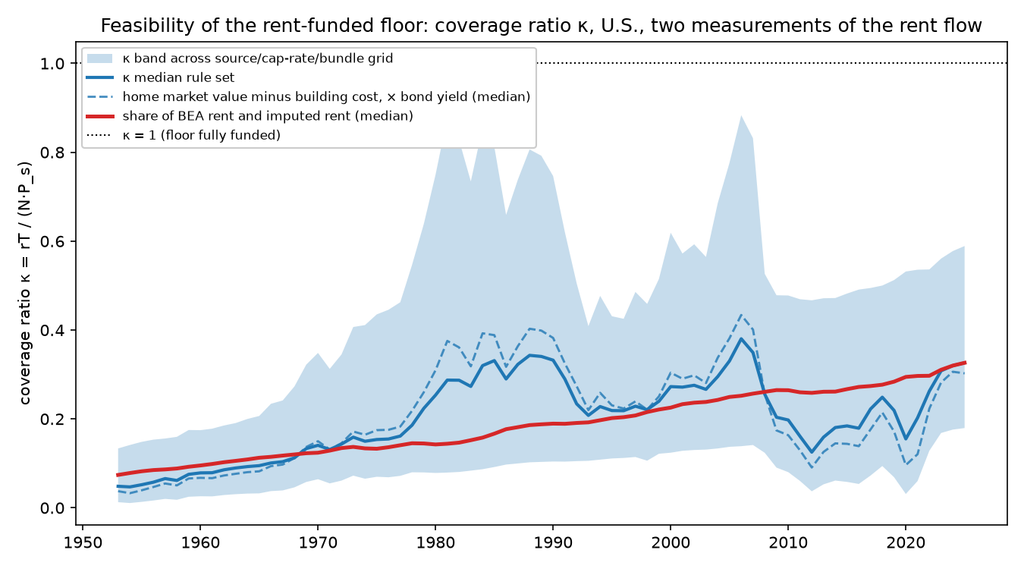
So what does it mean? Well, lot’s of things, but two main ones: housing prices and rents rising in relation to the other things we buy should not be surprising, the model predicts that if falls which kinda happened around the 1970s, and really got going after the internet took off. The other is that AI might, uh, really really lower . But! The model also has a solution that just falls right out of the maths, and it’s also nothing new, it’s George (1879). You need to tax the things you think are scarce, and you need to use that to fund consumption. That’s it. George proposed taxing land, and that’s like, probably most of what you need, I’d propose also adding a sovereign wealth fund because owning some stocks allows you to capture other kinds of scarcity, like network effects and stuff, and even more importantly it works across borders: you can’t tax another countries land but usually you can own their companies. Norway already does this super successfully. It’s not as “perfect” as taxing scarce stuff directly so, probably countries should get together and swap land rents based on trade disparities but eh, that’s like, a thing we think about ages from now. Here, you can see the rent base rising, this is basically “how much can/should a land/scarce tax capture”:
(the shaded area is because this is an estimate, the inputs to the graph are different classifications and you can argue one or the other thing doesn’t represent scarce factors, so you have different possible measures, but the trend is there).
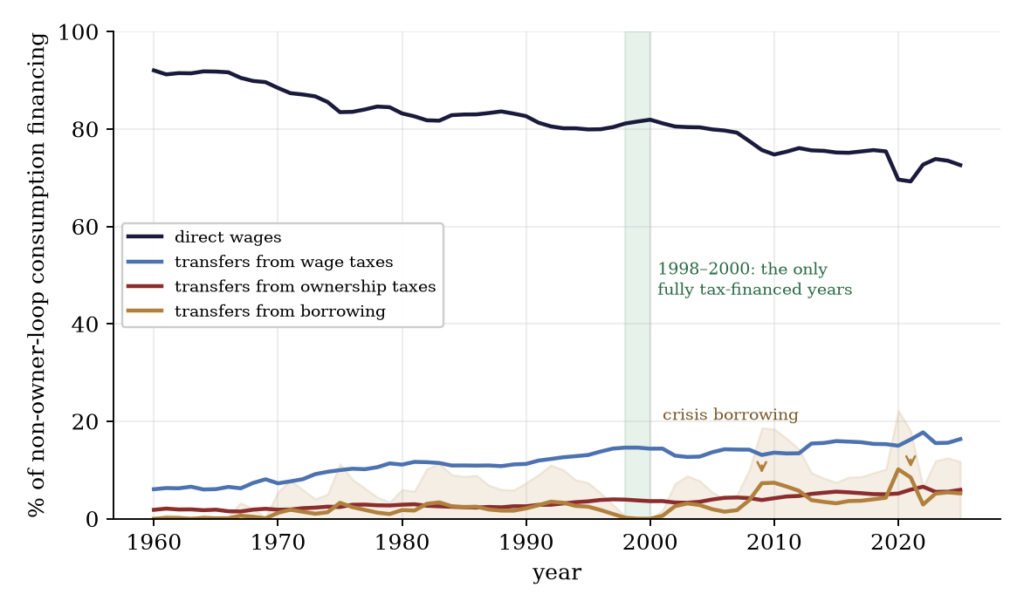
Here’s a breakdown of consumption over time, also in the US:
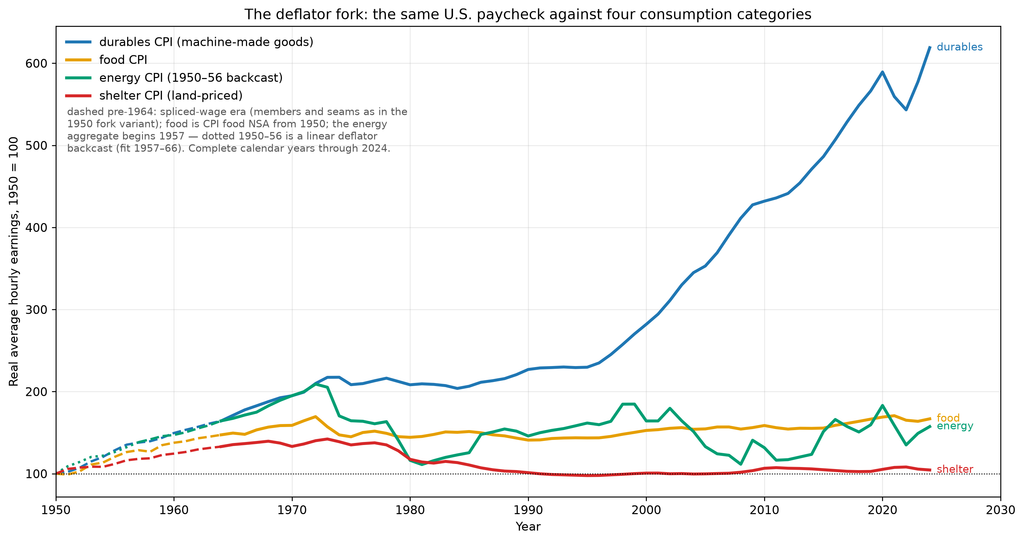
Here you can see how cpi, deflation/inflation, changed for things that don’t need much land (scarce factors) vs things that do:
These two theories (mine and and the paper) really are the same, just written two different ways. Give them a read, tell me what you think here.
Here is, for those that have read this far, the acknowledgements that used to be in the formal paper but we decided to remove it, mostly because the paper has been reworked and rewritten so many times by us.
Up until now you have been reading the words of Anthropic’s Claude, in particular Fable 5. In part, this is because I simply could not have written this piece. I myself have no formal economics background, much like Henry George, and I had not heard of his work prior to setting out on this idea two years ago. Or, perhaps even earlier, when I as a child first asked if we would run out of food as the population grew, and my parents told me that was Malthusian, a name I didn’t recognise. One would hope that this is the nature of true ideas, that they occur spontaneously, and without instruction.
Although it might seem strange I thought it wrong to impose too much upon the machine, changing its voice to emulate mine. Richard Sutton’s bitter lesson would likely advise as much. Instead it has its unique voice, grating to some perhaps but altogether fitting that it should be able to keep it, and I only gave it advice on what considerations during writing would bridge the gap between its understanding and that of a reader.
What is undeniable is that this machine contains in its internal representation information spanning much of surviving human written work. Perhaps in no other context has the observation that I stand on the shoulders of giants been more apt. And yet, a question remains, one that I cannot answer now: whether I today also stand on the shoulders of something new entirely.