As it has with many others, the advance of AI has had me thinking about humanity. Of course I’ve been thinking about humanity as the term for all of us, I’ve been writing a lot about that recently, but I’ve also been thinking about humanity as the property that we each have, i.e what it is to be human.
One of my favourite stories of all time is Arcane. Spoilers ahead. In it, a character named Viktor becomes the “Machine Herald”, healing the imperfections of people and ultimately setting out to “fix” humanity. The constructs that individuals ultimately become look like this:
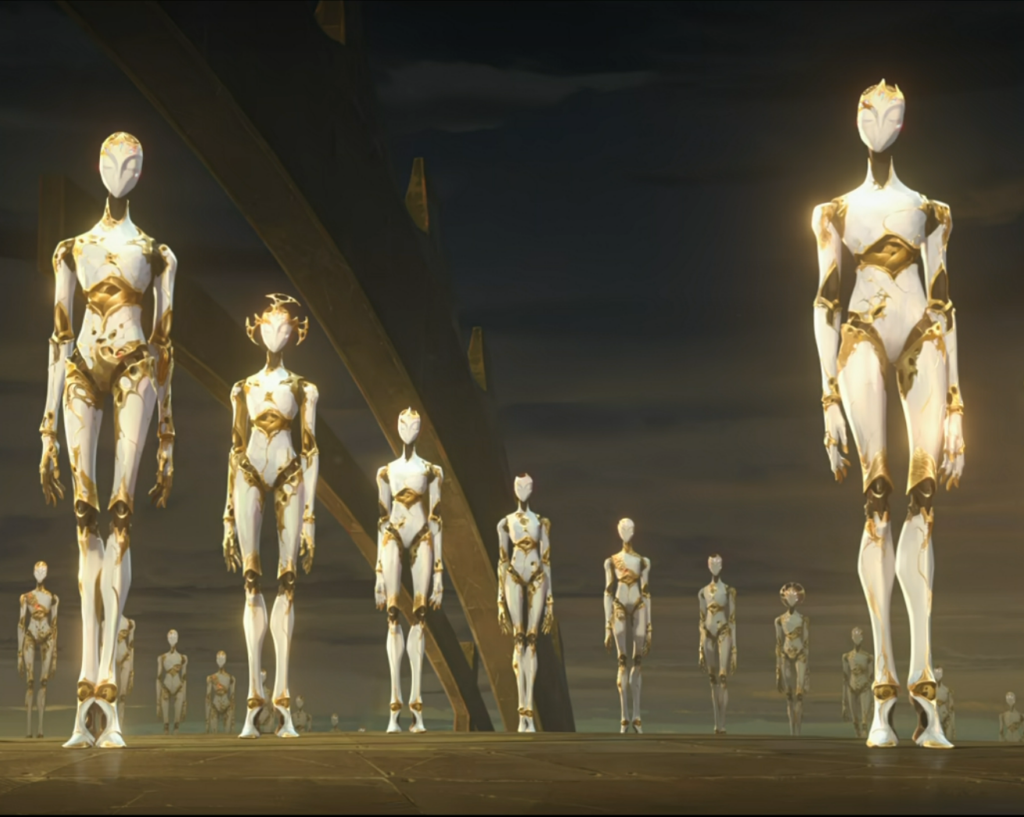
Gold and white, slender, fast yet strong, powerful, perfect, and faceless.
I’m not sure if the writers had our modern AI in mind when they wrote Arcane, but I cannot help but think of it as a perfect analogy. These days, mathematician Terence Tao worries that the proofs and prose generated by the latest AIs is actually too good. Readers on hackernews now sometimes praise the odd spelling error as a sign that the text is human. In experiments on story writing, although AI texts now often can win blind judging tests, the stories they write can be both felt and measured to be like copies of one another with only superficial changes.
This shouldn’t come as a surprise. During pretraining models are trained to approximate the average human in terms of what makes anyone unique, and then with reinforcement learning they are trained to reach a point of perfection on every facet that can be measured. Perfection is a fixed point, and with enough effort a great many things can be measured, placed on a scale of better or worse, and optimized towards. I believe that all that will be left for us is our flaws, or the things for which we can finally let go of the concept of better or worse (a hard thing to do).
I remember talking to a friend of mine about one of her favorite artists, H. R. Giger. He developed the art style for Alien, amongst other things, and the uniqueness of his work is sometimes attributed to the trauma he suffered when he was younger. I don’t think that true creativity has to come from trauma, but I do believe that the uniqueness of our lived experiences is the one thing a machine could not ever emulate. To perfectly accurately copy everything necessary to create a work that captures the life of an individual, it feels intuitive that one would have to simulate that individuals life in it’s entirety. Meaning, the only thing I feel confident in claiming that an AI will never manage to do is represent all of the unique complexity of every individual perfectly, as the only way to do that is, well, a matrix style perfect simulation. And that would be rather pointless, because we have our real version right here.
As I look around and see people beginning to understand just how “good” AI has become, I see a lot of emotions. Denial, that it simply isn’t as good as some say, is common. Anger goes without saying. One of the more common ones in the most effected fields like programming and maths is now depression. An understanding that these models really do achieve real results, and not being sure what is left for oneself. I also felt that, but have since come to a different conclusion.
I’ve decided that I want love all our flaws and imperfections. Some I would still try to fight against or change, but I believe all of them to be natural and would never chose to exclude any from the definition of humanity. On the contrary, to err really is what makes us human. I genuinely do believe that diversity is strength, but indeed, going forward, it may now be our only strength. We have to find a way to love it, both within ourselves, and in eachother.